Beachfront mansion flooded and uninhabitable; owner must wait for house to collapse into the sea to claim insurance
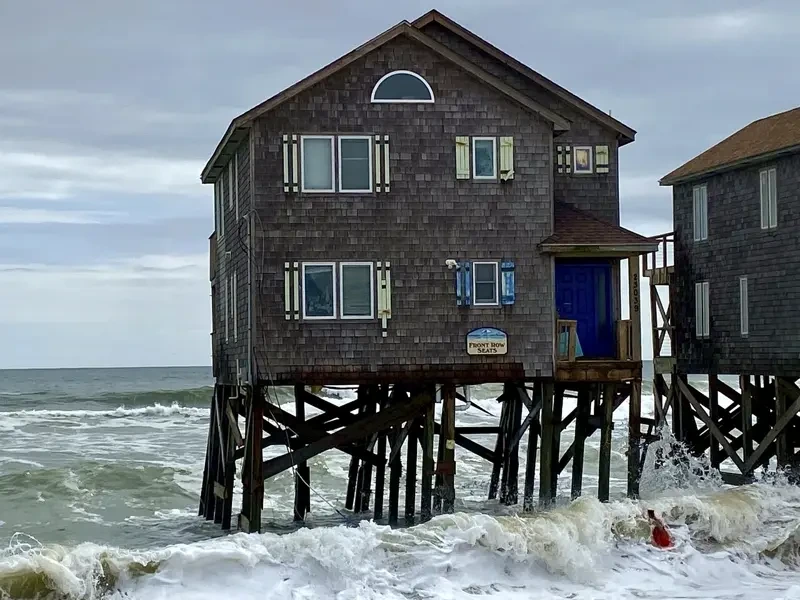
The financial website MoneyWise reported on the 22nd that Richard Foreman, a North Carolina man, owns a $1 million beachfront home that has become uninhabitable due to coastal erosion; the support pilings are frequently submerged in the ocean, and the stairs were long ago washed away. Foreman holds a residential flood insurance policy through the Federal Emergency Management Agency (FEMA), and under current regulations, he can only receive a payout if the house and all its contents fall into the sea.
The report notes that FEMA provides over 95% of the nation’s flood insurance. While FEMA covers claims for homes that collapse due to flooding, it does not fund efforts to save the structures. Consequently, Foreman has no choice but to wait for the house to fall into the ocean before he can collect the insurance settlement.
In an interview with National Public Radio (NPR), Foreman said, “From an environmental standpoint, a better approach would be to allow me to pick a day with good weather to demolish the house and gather up all the debris.”
He added, “But because of the rules of this ‘waiting-for-collapse’ game, the house will ultimately collapse during a storm, scattering debris for miles around.”
The report analyzes how FEMA’s current policies are detrimental to both homeowners and the environment.
In recent years, safety risks for beachfront homes have escalated due to factors such as coastal erosion, rising sea levels, and the washing away of rock and sand. Homes that were once safe from the surf are now in constant contact with seawater or are on the verge of collapse due to shifting foundations.
It is estimated that the U.S. loses approximately $500 million worth of coastal homes annually due to coastal erosion.
While coastal erosion can be slowed, homeowners have very limited options for saving their properties once the structural integrity is compromised.
Reide Corbett, a climate scientist at East Carolina University, stated that when a home can no longer be maintained, the only solution is to retreat from the front lines.
One of the most cost-effective ways to mitigate the impact of beach erosion is “coastal restoration.” The community must demolish all man-made structures along the coastline to restore the beach to its natural state.
However, the cost of demolishing or relocating homes could run into the hundreds of thousands of dollars—an expense many homeowners simply cannot afford without assistance from FEMA. Yet, FEMA regulations dictate that homeowners are eligible for compensation only after their houses have collapsed into the sea.